
Beyond the Deliverable: Turning Consulting Advice Into Client Value
A strong recommendation is only the beginning. The real measure of consulting value is what an organization can understand, decide, and do differently as a result.

Consulting professionals collaborating to translate insights and recommendations into practical solutions, informed decisions, and meaningful client outcomes.
Organizations rarely engage consultants simply because they need another report.
They engage them because something needs to move.
A strategic priority may have stalled. Leaders may need greater clarity before making a consequential decision. A transformation may be struggling to move from planning into execution. Or an organization may understand the problem but lack the structure, alignment, or capacity required to address it.
Whatever the starting point, there is an important distinction between delivering consulting work and delivering client value.
A well-written report can be a useful deliverable. A compelling presentation can communicate an important recommendation. But neither automatically creates change.
The real value of a consulting engagement develops through the progression from alignment to evidence, evidence to insight, insight to practical solutions, and solutions to action.
That requires more than producing the work that was promised.
1. Commence: Start With the Outcome, Not the Activity
Before interviews begin, data is analyzed, or recommendations are developed, there should be clarity around one fundamental question:
What should be different because of this engagement?
That question moves the conversation beyond activities and deliverables.
For example, producing a revised strategy is a deliverable. Creating sufficient leadership alignment around strategic priorities to enable execution is an outcome. Developing a transformation roadmap is a deliverable. Establishing the governance, ownership, and sequencing required to move that roadmap forward is an outcome.
The distinction matters because the desired outcome should shape how the engagement is designed.
At commencement, that means establishing:
the problem or opportunity being addressed;
the intended outcome and measures of success;
what is inside and outside the scope;
who needs to participate;
what information and resources will be required; and
how decisions, risks, dependencies, and changes will be managed.
This creates structure without assuming everything is already known.
Strong engagements need both direction and flexibility. The objective should be clear, but the path may evolve as new evidence emerges.
2. Collect: Find the Evidence That Matters
Once the engagement is aligned, attention turns to understanding what is actually happening.
That may require quantitative data, operational records, interviews, observations, stakeholder perspectives, process documentation, customer insights, benchmarking, or some combination of these sources.
But effective diagnosis is not a competition to collect the most information.
The better question is:
What evidence do we need to understand this issue well enough to make a sound decision?
Too little information creates obvious risk. Conclusions may be based on an incomplete picture.
But excessive collection creates a different problem. It consumes time, increases cost, disrupts client teams, and can create enormous amounts of information without necessarily creating greater understanding.
Experience also introduces another challenge. Consultants naturally enter engagements with hypotheses based on patterns they have seen elsewhere. That experience can accelerate diagnosis—but it can also narrow it.
A useful hypothesis should guide inquiry, not predetermine the answer.
The consultant therefore has to balance experience with curiosity: knowing enough to ask better questions while remaining open to evidence that challenges the original assumptions.
3. Consider: Turn Evidence Into Insight
Information becomes valuable when someone can make sense of it.
This is where consulting moves beyond data collection into interpretation.
Patterns have to be identified. Assumptions have to be tested. Symptoms need to be separated from root causes. Competing explanations need to be considered. And eventually, a large amount of information must be distilled into something decision-makers can actually use.
That requires judgment.
An organization may have dozens of visible problems, but not all of them carry equal weight. Some may be symptoms of a deeper issue. Others may be interconnected. Still others may be real but outside the organization's immediate ability to influence.
A useful discipline at this stage is to ask:
Is there another reasonable interpretation of the evidence?
That question creates space for challenge before conclusions become recommendations.
It is also where practicality enters the analysis.
A recommendation can be intellectually impressive and still fail if the organization cannot implement it. Conversely, limiting recommendations only to what feels comfortable can prevent meaningful change.
The strongest recommendations sit at the intersection of insight, feasibility, and organizational reality.
4. Create: Make the Recommendation Usable
Once the analysis is sound, the challenge becomes translating it into something the client can use.
That may be a strategic roadmap, governance model, implementation plan, executive presentation, operating framework, process redesign, workshop, or another form of deliverable.
But the format should follow the client's need—not the consultant's preference.
Instead of asking:
How do we present everything we discovered?
ask:
What does this organization need in order to understand the recommendation and move forward?
That change in perspective matters.
An executive team making a decision may need a concise synthesis of the evidence, trade-offs, and options. A team responsible for implementation may need far greater detail around sequencing, ownership, dependencies, risks, and measures of success.
Creating the deliverable is therefore not simply the final packaging of consulting work. It is part of the thinking itself.
Trying to communicate an idea clearly often reveals where the analysis remains incomplete.
“A deliverable is not the same as delivered value”.
A polished presentation matters.
Usability matters more.
5. Counsel & Consult: Help the Client Move Forward
One of the easiest ways to weaken a strong consulting engagement is to treat the final presentation as the finish line.
It rarely is.
Recommendations may need to be explained, challenged, refined, prioritized, or translated into decisions. Leaders may disagree about what the findings mean. Teams may need help understanding implications for their work. Difficult findings may require candid conversations.
The consultant's responsibility is not simply to present the answer and leave.
It is to help the client understand:
What did we learn?
Why does it matter?
What choices does it create?
What happens next?
There is also an important balance between providing expertise and creating dependency.
Some situations require direct expert advice, particularly where urgency or specialized knowledge is involved. In others, the greater long-term value may come from strengthening the client's ability to solve similar problems independently.
The appropriate approach depends on the organization's needs, capabilities, urgency, and desired outcome.
Either way, the client ultimately owns the decision.
Good consulting supports that ownership rather than replacing it.
Five Stages, One Value Chain
The five stages are useful individually, but their real strength lies in how they connect.
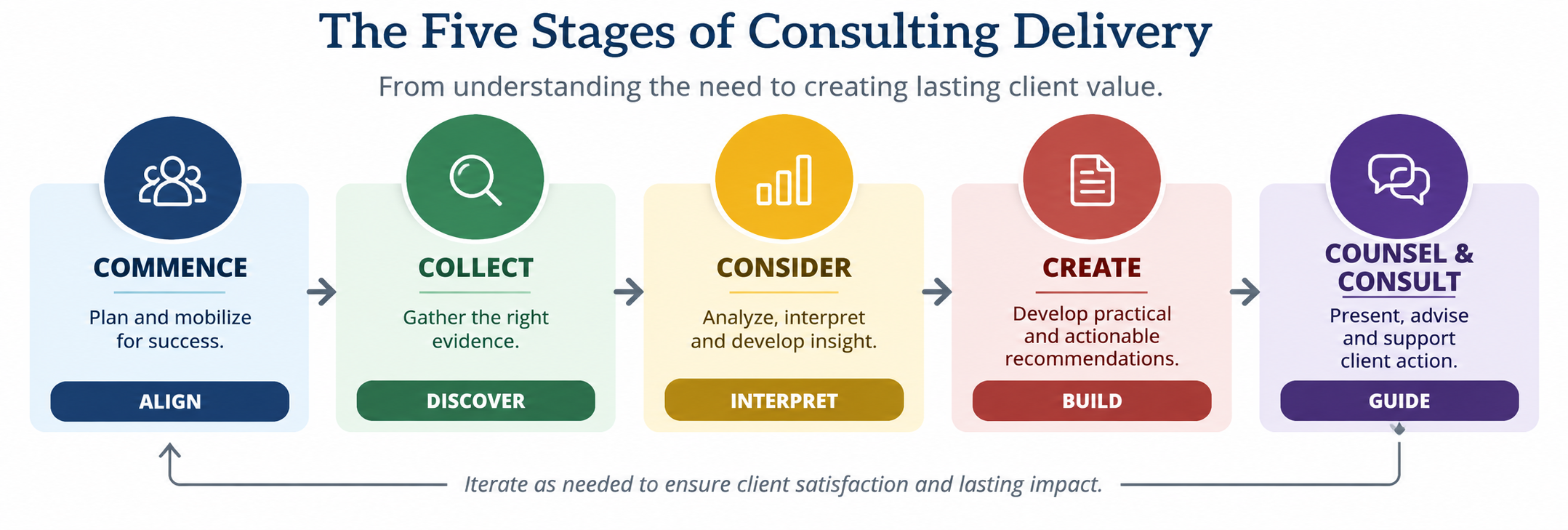
From alignment to action: the five stages of effective consulting delivery.
Weak alignment affects what information is collected.
Weak evidence undermines analysis.
Weak analysis cannot be rescued by an attractive presentation.
And even an excellent recommendation may create little value if the organization cannot understand, accept, or act on it.
The process is also rarely perfectly linear.
New evidence may require additional discovery. Analysis may expose an assumption that needs to be tested. A draft recommendation may reveal an unanswered question. Client feedback may require refinement.
Returning to an earlier stage is not necessarily a failure of the process.
Sometimes it is evidence that the process is working.
From Advice to Execution
Organizations do not experience consulting value through the number of interviews completed, slides produced, workshops facilitated, or pages delivered.
Those are activities.
A more meaningful question is:
What can the organization understand, decide, or do differently because of the engagement?
That is where consulting begins to connect with execution.
Align around the outcome.
Discover the evidence that matters.
Interpret what it means.
Build something the organization can use.
Guide the transition from recommendation to action.
Because ultimately, the goal is not simply to deliver advice.
It is to help organizations move forward.
Turning Strategy Into Measurable Execution
At Stratagem Global Solutions, we help organizations bridge the gap between strategy and execution by bringing clarity, structure, and accountability to complex priorities.
Our work spans Strategy Execution & Program Delivery, Operational & Process Improvement, and Transformation & Change Enablement—helping organizations move from defining what needs to change to creating the structures needed to make change happen.
Have a strategic priority that is struggling to move from intention to execution?
Start a conversation with Stratagem Global Solutions.
